
Start Finding Rialto Residents
A Rialto residents directory search works best as a chain. Start with the strongest clue already in hand. A street address leads to the San Bernardino County Assessor's parcel system. A full name may lead to a court party search, a business filing, or a professional license. An older family question often belongs in census schedules, city directories, newspapers, or cemetery records instead of a current roll.
The official trail has limits. An assessment record can show a public owner or mailing address, but it does not prove occupancy. A deed names parties to a recorded instrument, not every person in a household. The county voter tool authenticates the voter and returns personal election information; it is not a public street list. A careful Rialto residents directory search names the source and date for each fact. A useful starter sequence is:
- Put the known name, street, or time period in writing and preserve spelling variants, initials, compound surnames, and former surnames.
- Use San Bernardino County govPIMS to locate an address, APN, situs, and any public owner or mailing detail.
- Carry the APN, legal description, or owner name to the ARC recorder index and search the grantor and grantee sides.
- Use CAP, vital-record applications, business filings, or license records to test whether the name and date fit the same person.
- For older residents, move to census, directory, newspaper, cemetery, archive, and library channels, then request a specific missing municipal record if needed.
Where Rialto Resident Records Are Kept
Rialto records are split between city custodians and offices in San Bernardino. The county seat is not Rialto. The Assessor-Recorder-Clerk holds the main property, deed, vital, and clerk layers; the Superior Court holds case files; and the Registrar of Voters is on Rialto Avenue in San Bernardino, a geographic name trap that can send a request to the wrong city. The California Public Records Act, now codified at Government Code sections 7920.000 and following, is the fallback for identifiable city records that are not exposed through a public search.
San Bernardino County ARC Recorder
222 W. Hospitality Lane, 1st Floor
San Bernardino, CA 92415-0022
909-387-8306
San Bernardino County Assessor
County property information service
San Bernardino County, CA
909-387-8307
San Bernardino Registrar of Voters
777 E. Rialto Avenue
San Bernardino, CA 92415-0770
909-387-8300
The offices answer different questions. ARC's recorder index is a catalog of recorded instruments. The assessor portal is an assessment system. The elections gateway is a personalized service. The City Clerk can route permits, contracts, minutes, business-license data, and other existing municipal records when a public index does not exist.
Why Rialto Records Live in San Bernardino
City identity and records geography are not the same thing. Rialto incorporated in 1911, while San Bernardino County was created in 1853. A nineteenth-century deed, probate file, tax book, or naturalization record therefore predates the modern city and belongs to a county, state, federal, or archival system. The present county offices in San Bernardino carry the strongest current property and case trails.
Rialto's growth also changes the likely source. Central streets may have a long chain of deeds, directories, maps, and newspaper notices. A later tract may have cleaner parcel and permit evidence but no early directory footprint. The official City of Rialto resources page is a good starting point for municipal departments, while ARC and the court remain the source custodians for county property and case evidence.
For a visual orientation to the municipal channel, the official Rialto site is represented below.
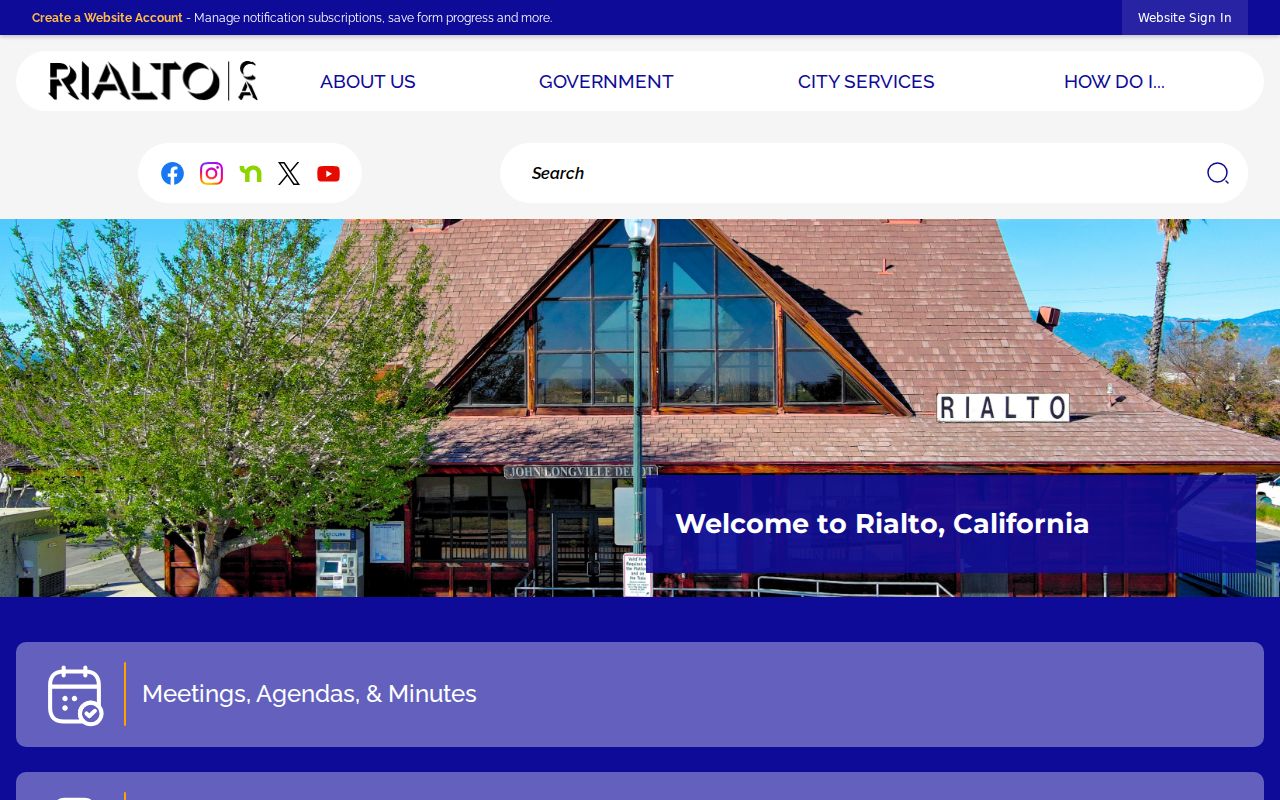
The city landing page points toward departments and services, but a staff listing or public-role directory is not a resident roll. Treat the contact as a route to a record, not as proof that an official lives in Rialto.
Rialto Resident Records: Parcel to Deed
The most useful Rialto address path is address to APN, APN to legal description, legal description to recorded parties, and recorded parties to a dated instrument. That bridge matters because the ARC recorder index does not accept a street address as a substitute for a grantor, grantee, document number, or recording reference. The parcel system supplies the starting identity; the recorder supplies the transaction catalog.
The distinction is easy to miss. A situs address is the physical location of the parcel. A mailing address is where assessment correspondence goes. A legal description identifies the land through a tract and lot, block, or another description. A current owner display can be useful evidence of an association with a parcel, but the assessor system is not a legal-title opinion and does not establish who occupies the property.
- APN
- The assessor parcel number, used to keep a parcel distinct from a similar street address.
- Index
- A catalog of record fields. It points to a document but is not the document image.
- Grantor and grantee
- The party giving an interest and the party receiving it in a recorded instrument.
- Criss-cross directory
- A reverse directory that starts with a street address and names an occupant or business when that volume includes the feature.
The full by-address chain belongs on the Rialto street directory page. The key home-page lesson is simple: carry the parcel identifier into the deed search instead of expecting the deed index to browse a whole street.
Today's Rialto Resident Directory Sources
No single current Rialto residents directory contains every household. Each source has a keeper, a purpose, and a boundary. Use the source that answers the question rather than treating a name hit as a complete identity record. The result is a working Rialto residents directory built from dated, limited records, not a claim that one office has the whole picture.
| Source | Who It Lists | Keeper | Access |
|---|---|---|---|
| Assessment parcel | Public owner or mailing fields where allowed | County Assessor | Free map and search |
| Recorder index | Grantors, grantees, document type and date | ARC Recorder | Free index; image counter or order |
| My Elections Gateway | The authenticated voter's status and districts | Registrar of Voters | Personal sign-in |
| City staff directory | Officials and department contacts | City of Rialto | Online staff search |
| Historical directories and census | Past households at an enumeration or directory date | Archives and libraries | Collection access varies |
Property data helps anchor a place. The recorder adds the legal transfer trail. A court, vital, business, or license source can test a name and date. Historical collections answer a different question about who appeared at an address in the past. The current resident lookup path becomes stronger when two independent sources agree without overstating what either one proves.
The ARC index screen below represents the official recorder catalog. It is useful for document number, date, title, grantor, and grantee, but it does not replace the underlying image.
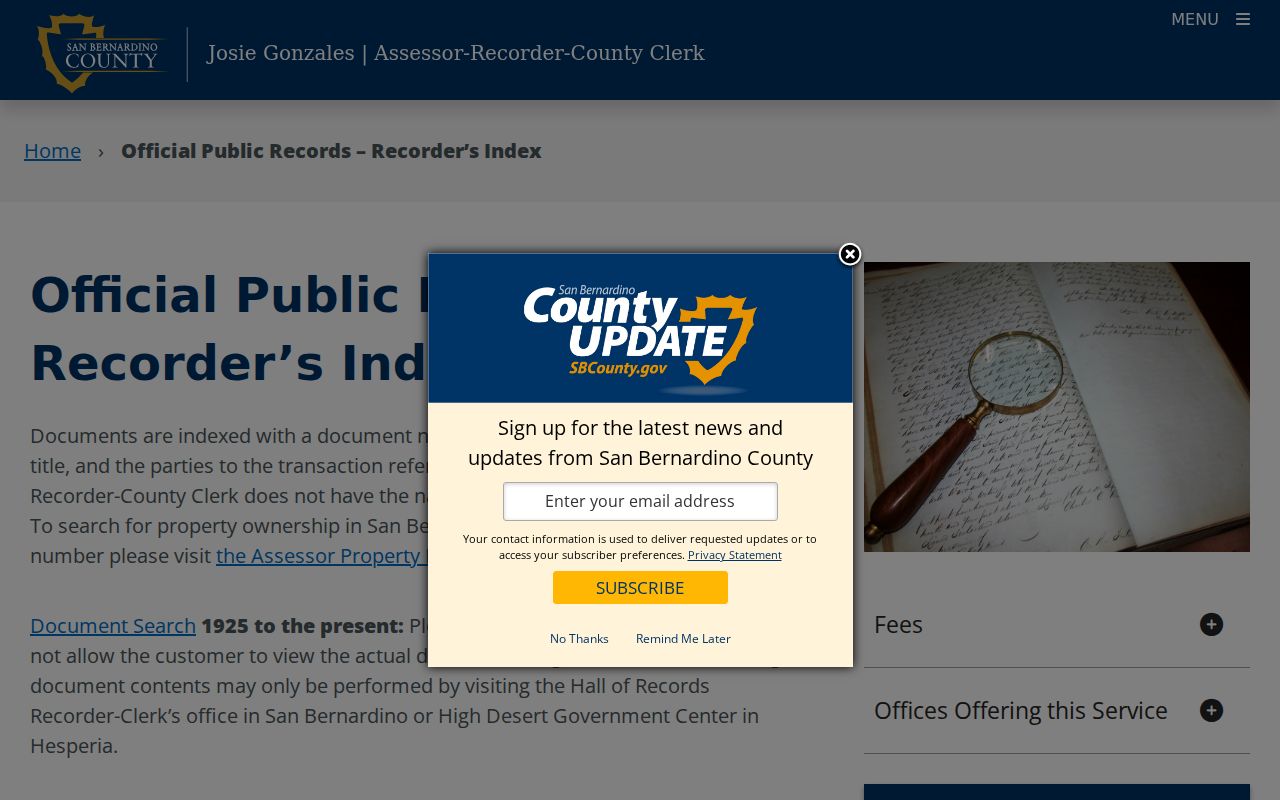
The image-access limit is practical, not a dead end. Online copies can be ordered, mail requests are available, and counter inspection remains the route for document images.
Rialto govPIMS for Resident Records
San Bernardino County's govPIMS and Parcel Access tools are the home page's most useful address-first source. The official user guide documents searches by parcel number, name, situs, assessor map book, parcel map, tract map, attached parcel, and property ID. The live utility also separates a main situs from a mailing address and presents tabs for property information, roll values history, parcel history, owner history, supplement history, land, single-family residence, and other characteristics.
| Search field | What to enter or select |
|---|---|
| Parcel number | Preserve the APN format shown by the county, including leading zeroes or separators. |
| Address | Street number and name, with city when the live form requests it. |
| Name Search Utility | First name, last name, active or inactive names, and formatted or unformatted name choices. |
| Map, tract, or parcel map | Browse the county's map geography when a street search is not enough. |
| Result tabs | Property Info, Roll Values History, Parcel History, Owner History, Supplement History, Land, SFR, and Other Chars. |
Owner-name display is constrained by California Government Code section 7928.205 and related protections. A missing name is not proof that a parcel has no owner. Use the map and APN as the stable keys, then move to ARC or a city request for the next record.
The county property-information landing page shown below is the source link for the parcel route.
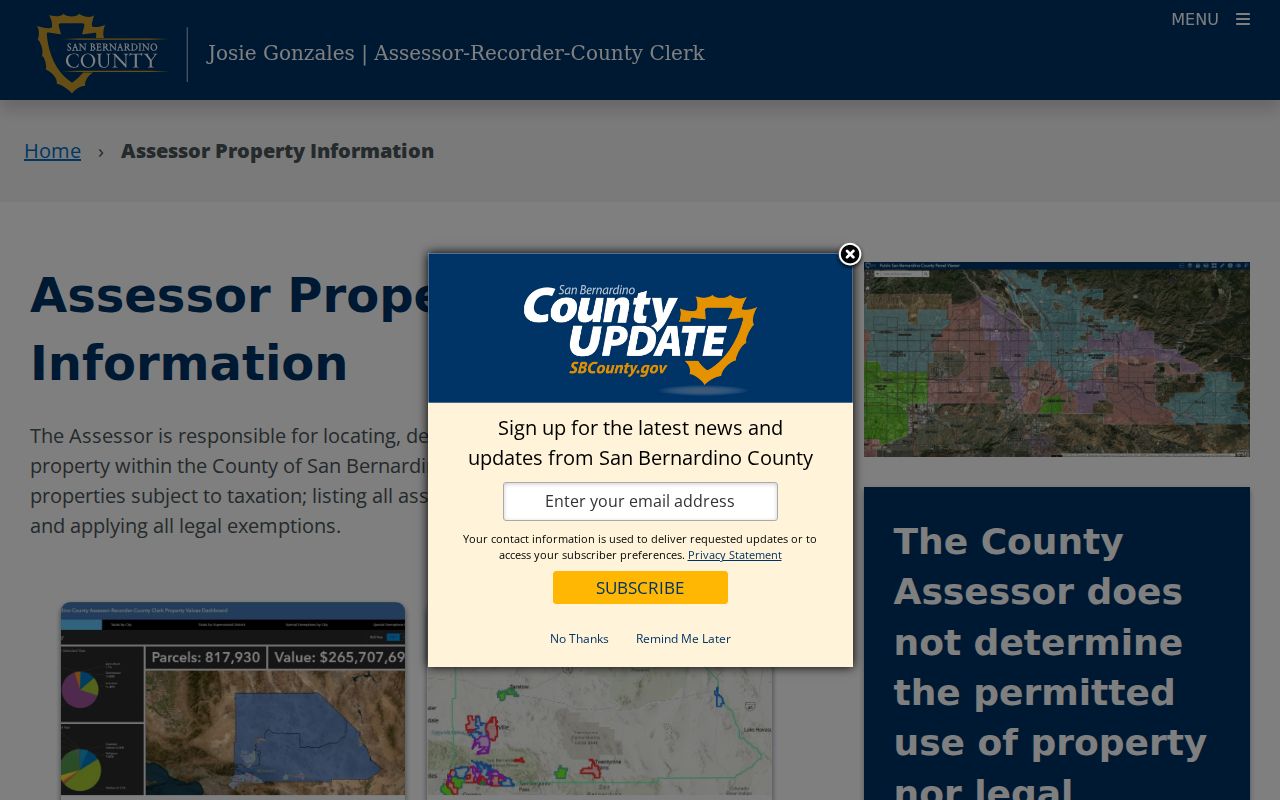
Assessment values and owner history help with dates and parcel continuity. They do not decide legal title, permitted use, or occupancy.
Where Rialto Resident Voter Information Stops
My Elections Gateway is an authenticated self-lookup. After sign-in it can return registration status and locations, districts, a voter information guide or sample ballot, polling-place details, drop-off information, provisional status, elected officials, and campaign-finance links. The page says voting history is currently unavailable online and directs the voter to call 909-387-8300.
California Elections Code sections 2188 and 2194 set the boundary. Approved election, scholarly, journalistic, political, or governmental purposes may support a voter-file request, but commercial use is prohibited. The statewide file request and the county application require a permitted-purpose explanation, identification, and security controls. A specific-voter request can cover up to ten records; the published county schedule states a 3 to 5 business day approval-to-delivery period.
The elections information page below shows why an authenticated voter tool is different from a public Rialto residents directory.
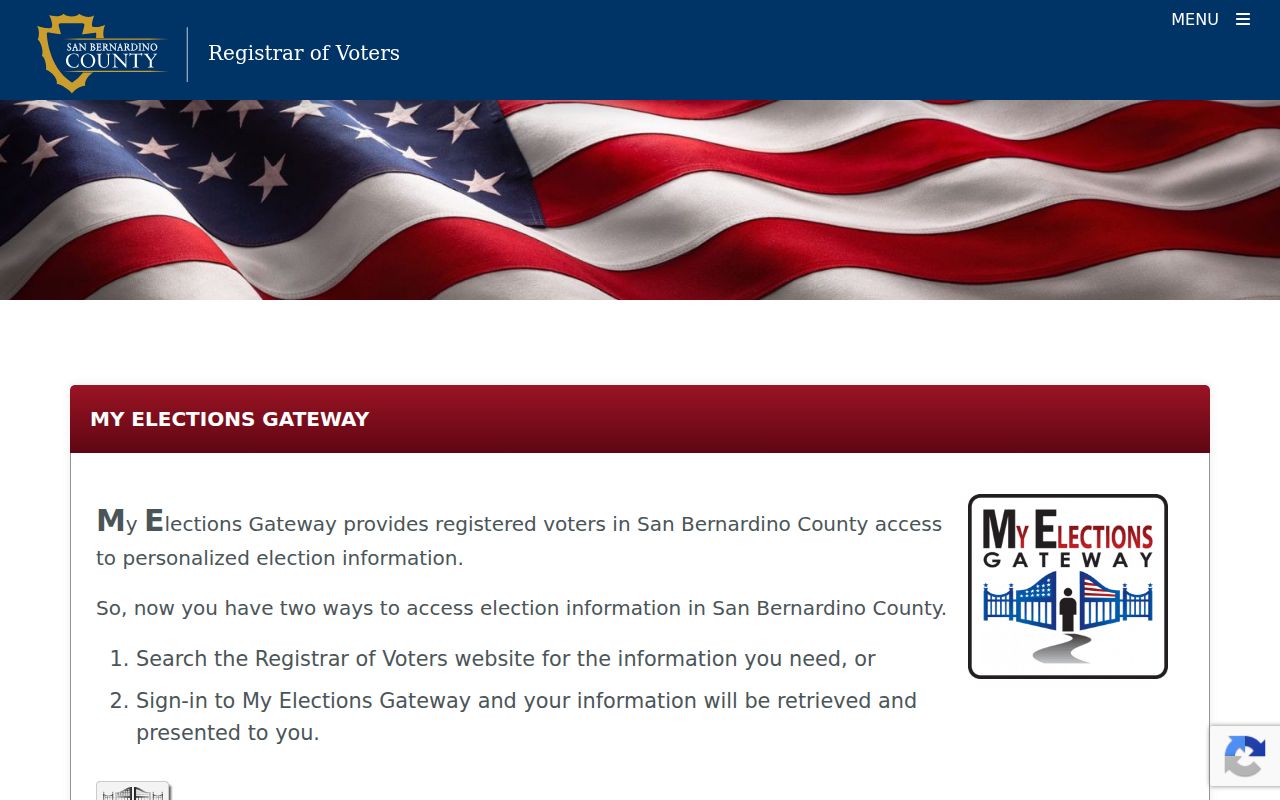
Even an approved file is not authority to publish a neighborhood list. Confidential voters and Safe at Home participants receive additional protection, and signatures, driver's-license digits, and Social Security numbers are not released through the approved-purpose process.
Rialto City Clerk's Records Fallback
When no public portal exposes the record, the Rialto City Clerk's written request route is the documented fallback. The form asks for a specific description and relevant dates or date ranges. Its own example requests permits for an address, which makes it useful for an address history when the online permitting view does not answer the question. Ask for an existing record or a machine-readable export, not for staff to build a new directory.
The current city records page lists 290 W. Rialto Avenue, 909-820-2519, and Monday through Friday service from 7 a.m. to 6 p.m. A request can be delivered or mailed to the Clerk, emailed to cityclerk@rialtoca.gov, or submitted through the linked request portal. Current pricing is $0.30 per paper page, with no charge for emailed copies. The older PDF still prints a different address and $0.25 figure, so use the current page for submission and price.
| Request detail | What the form requires |
|---|---|
| Record requested | Specific description, with a date or date range when known. |
| Requester | Name, phone, mailing address, city, state, ZIP, signature, and date. |
| Delivery | Postal mail, special delivery, email, or in-person pickup. |
| Determination | The CPRA normally gives an agency 10 calendar days to determine whether it has disclosable records, with an extension for unusual circumstances. |
The city public-records request image below emphasizes the form's address-based permit example.
City records may include permits, inspection dates, contractor or applicant names, code notices, business-license data, council minutes, contracts, and board or commission rosters when retained and nonexempt. An applicant's association with a parcel is not proof of occupancy.
Rialto Court Records Before and After 1998
Rialto court research belongs with the Superior Court of California, County of San Bernardino. The Court Access Portal, or CAP, provides case information across civil, criminal, family, probate, small claims, and traffic categories, subject to the portal's terms and case-specific access rules. The court warns that data for cases filed before 1998 are limited. Older-case questions go to the district clerk where the case was filed or heard.
A CAP result can show a case number, title and party names, category, filing date, status, location, events, hearings, and register-of-actions entries. A detail screen may expose parties and counsel. Sealed cases, juvenile matters, confidential adoptions, and protected portions of family or criminal matters may be absent or redacted. A name hit is not a statewide history certificate and an allegation is not a finding.
| Search route | Best use | Boundary |
|---|---|---|
| CAP case number | Open a known case and follow events | Exact number is the strongest key |
| CAP party or business name | Find a likely case for comparison | Name searches may require credits; same-name control is essential |
| District clerk | Older or copied case-file requests | Use the filing district, not the administrative-records mailbox |
| PACER Case Locator | Federal district and bankruptcy trails | Account required and judiciary fees apply |
The San Bernardino CAP portal is represented below. It is a case-information source, not a general resident list.
For a federal case, use PACER and match the district, party role, dates, and case number. That extra anchor keeps an ordinary name from becoming a false identification.
Rialto Vital Records Have Two Access Levels
Birth, death, and marriage records can connect a resident with family, event, and place facts, but California uses copy authority rather than one simple opening date. San Bernardino County ARC issues local certificates and marriage licenses purchased in the county. California Department of Public Health Vital Records handles statewide applications and reports record-specific coverage. A divorce file belongs to the Superior Court; a CDPH dissolution certificate is not the decree.
An authorized certified copy may be identity-usable for an eligible requester who completes the sworn statement and, for a mailed request, notarization. Most other requesters may buy an informational copy marked unusable to establish identity. Confidential marriage records remain limited to the parties or a court order. The 2026 state schedule lists birth at $31, death at $26, marriage at $19, and dissolution at $18. County fees differ: its 2026 birth fee is $34, death $26, and marriage $19, with card and mail charges described by ARC.
| Record | Custodian | What the copy can add | Access note |
|---|---|---|---|
| Birth | County ARC or CDPH-VR | Event and parent linkage | Authorized or informational copy |
| Death | County ARC or CDPH-VR | Event, place, and family lead | Some signatures and identifiers are redacted |
| Public marriage | County ARC or CDPH-VR | Spouse and event linkage | Coverage depends on custodian and year |
| Confidential marriage | County clerk | Restricted certificate route | Parties or court order only |
The California vital-records hub below shows the statewide channel.
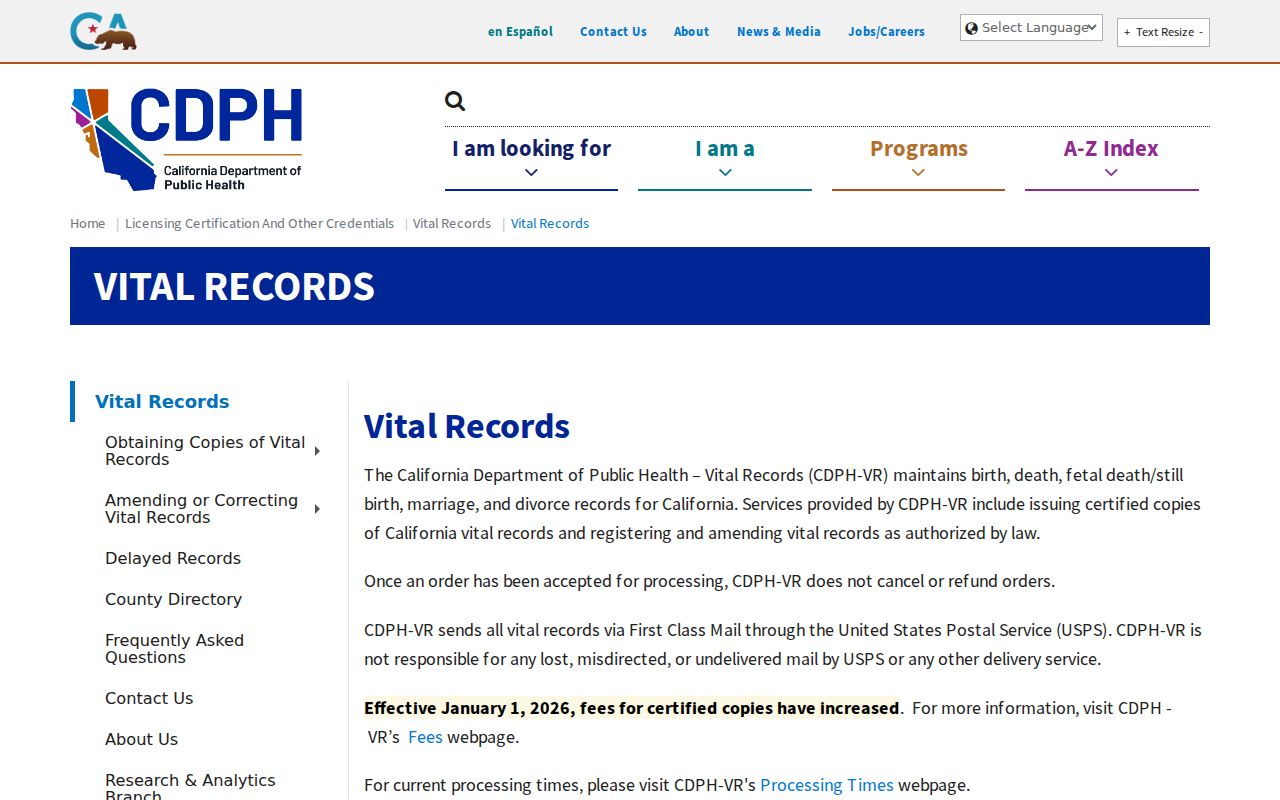
CDPH applications use the registrant or decedent name, event city and county, date, parent or spouse details, requester relationship, purpose, signature, and payment. Mail applications go to Sacramento, and the fee is retained when no record is found.
Rialto's Historical Resident Directory Shelf
Past Rialto residents require a different toolkit. NARA verifies San Bernardino directories that include Rialto for 1930 and 1933 to 1934. The FamilySearch catalog identifies the 1949 San Bernardino Directory Co.'s San Bernardino city directory: including Colton and Rialto, catalog 2058594. Exact local library shelf runs and a digitized Rialto volume were not verified, so a researcher should ask the local library about city directories, reverse telephone directories, Rialto Record microfilm, yearbooks, obituary files, and in-library databases rather than assume a run.
NARA Riverside serves Southern California and offers federal census schedules, naturalization and federal court material, military records, passenger-arrival resources, microfilm, databases, and staff or volunteer help. Federal population schedules are open through 1950 under the 72-year rule. The 1890 population schedules were largely destroyed nationally, so a missing census year must be bridged with deeds, directories, newspapers, tax books, maps, and family records. The full historical shelf has its own Rialto city directory treatment.
A directory entry can show a name, spouse notation, occupation, employer or business, home marker, street address, and an owner or renter symbol only when the volume defines that mark. Read the abbreviation key first. A reverse directory begins with a street number and occupant or business, but the exact feature must be confirmed in the volume.
Special-Purpose Rialto Resident Rolls
Some official search tools identify people only for a narrow public purpose. The San Bernardino County Sheriff inmate locator covers county custody. California's CDCR CIRIS incarcerated-person locator covers the state prison population. Megan's Law provides a statutory public registry with its own warning. The Department of Consumer Affairs license search, the Secretary of State business index, and the State Controller unclaimed-property search add professional, entity, or reported-owner clues. None is a complete list of Rialto residents.
The county jail image below comes from the San Bernardino County Sheriff inmate locator.
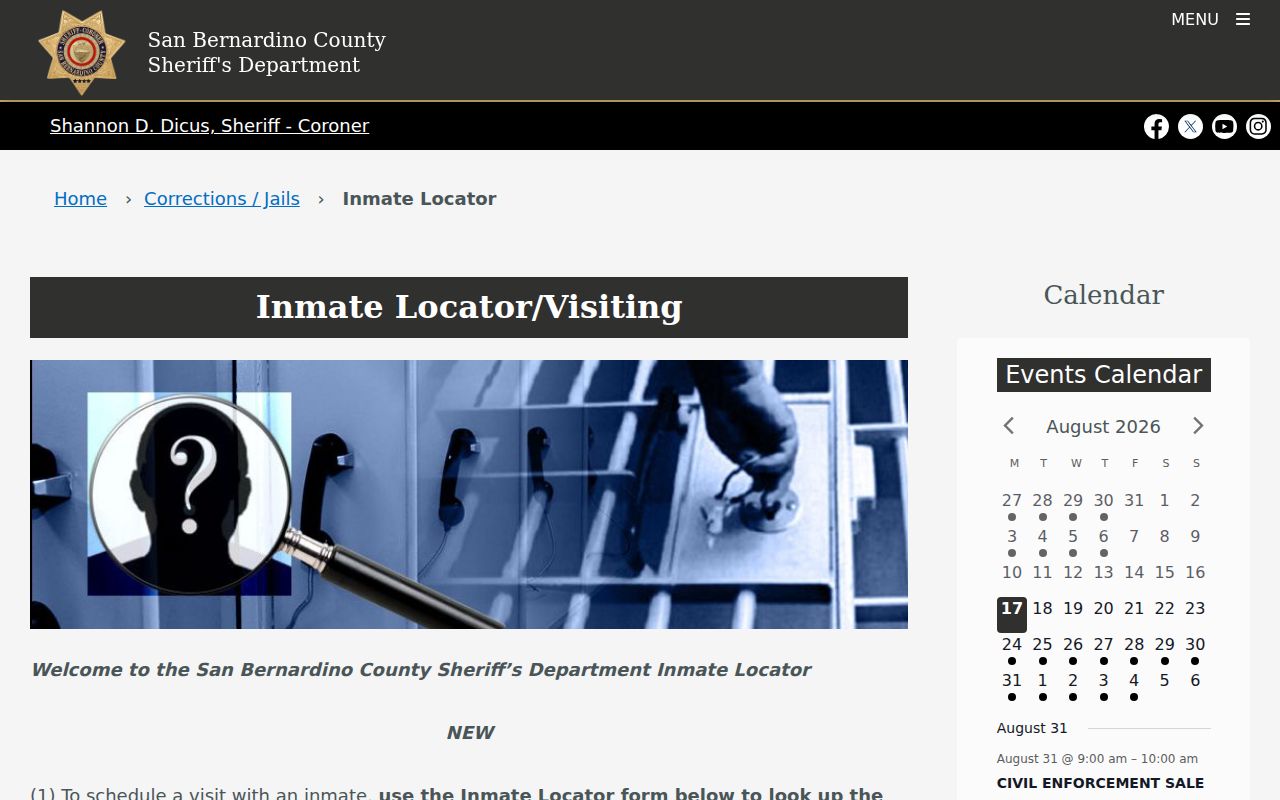
A custody roster is time-sensitive and does not show every arrest, disposition, or prior address. Use a record for its stated purpose, check the date, and move to the proper custodian when a question concerns a deed, court case, license, or family event.
Rialto Business Records as Identity Anchors
Business and professional records can separate two people with the same name without turning a business association into a home address. California bizfile Online can show an entity number, type, status, jurisdiction, formation information, principal or mailing address, agent, and published filings. County fictitious-business-name records answer a different question. A local license, a legal entity, and a DBA should be kept separate.
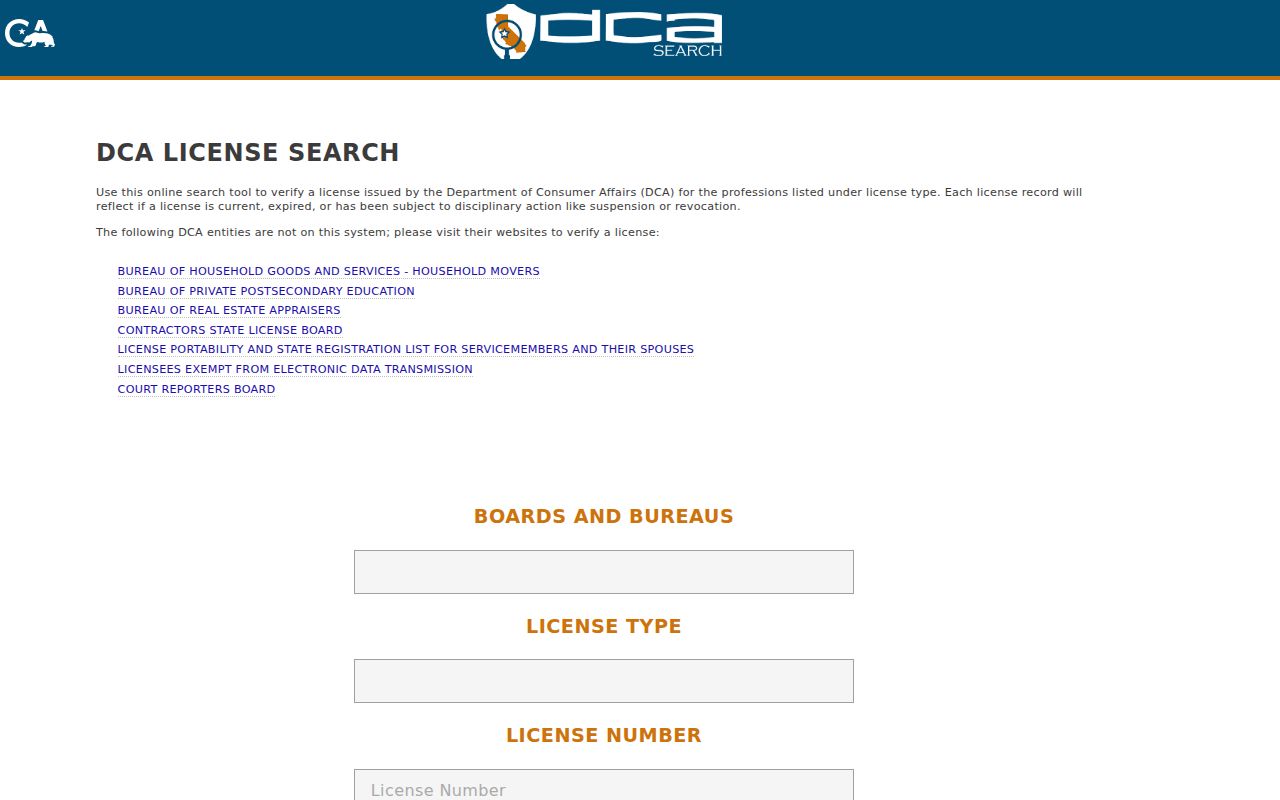
The California Department of Consumer Affairs search is another date and name anchor. Board-specific results may show license number, type, status, issue or expiration, address, and a discipline link. Use the board source for the authoritative detail. The two images below are assigned to the Rialto residents directory because both systems can help verify which person a public record refers to.
California's DCA license search is shown here.
Business entities are searched through California Secretary of State bizfile Online.
These sources are useful for a public affiliation, date, or entity trail. They do not establish private residence without a separate official record that actually addresses the property or household question.
Rialto Resident Records: Protected Dates
A reliable Rialto residents directory search records when each result was seen and what the record actually says. Compare the assessment roll's as-of date with a deed's recording date, a court filing date, a license issue date, and a directory year. A current-looking name can reflect an old filing, an inactive entity, an absentee owner, or a protected field that is not displayed.
California's Safe at Home program gives eligible participants a substitute mailing address and confidential voter-registration options. It can also support address substitution on specified deeds and change-of-ownership records. The California Consumer Privacy Act and California Privacy Rights Act provide covered-business rights to know, delete, correct, limit, and opt out, while government source records follow their own statutes and exemptions. California's DROP system can send one deletion request to registered data brokers, but it does not erase the ARC, court, assessor, or elections source.
Lawful personal use. Public records support family history, reconnecting, estate research, and civic curiosity. Do not use a Rialto residents directory search to stalk, harass, threaten, impersonate, or harm anyone, and verify a record with the custodian before relying on it.
The final check is not a larger database. It is a better match: a name, a place, a date, and at least one independent source that agrees without revealing protected information.