
Trace a Rialto Street Address
A useful Rialto street directory trail follows a fixed order: address to APN, APN to the current assessment record, owner to deed, deed to an earlier party, then authenticated voter information and older directories. The order matters because the county assessor can locate a parcel, while the recorder indexes recorded instruments by parties and recording details. A map can show the parcels along a street, but it does not supply a public list of everyone who lives there.
Start with the most exact address you have. Save the returned parcel number, situs, mailing address, map or tract reference, and the date shown by the portal. Treat the current owner as a lead rather than a final title opinion. Use the deed index to test the transfer, use the voter channel only for an approved purpose or a person's own authenticated record, and use a reverse directory or census entry when the question is who occupied the address at an earlier time.
- Enter the street number and name in San Bernardino County govPIMS, or use an APN when one is already known. Confirm the selected parcel on the map.
- Read the property detail for owner information that may lawfully display, the separate situs and mailing fields, parcel history, and the relevant roll date.
- Use the owner name as a grantor or grantee search in the ARC recorder index, then order or inspect the acquisition instrument and its legal description.
- For voter information, use My Elections Gateway for the person's authenticated self-lookup. A street-wide voter list requires an approved county or state request and cannot be republished as a casual block roster.
- For past households, ask the local library about reverse directories, yearbooks, newspaper files, and genealogy databases, then compare any entry with census, deed, permit, or obituary evidence.
Search Rialto Street Records by Address
Each address-keyed source answers a different question. San Bernardino County Assessor-Recorder-Clerk records can connect a street location to a parcel and recorded parties. Rialto municipal files can date work or code activity. Historical sources may identify an occupant at an earlier date. The voter system is deliberately narrower because it is an authenticated service or a purpose-limited file request, not a public street directory.
| Record Set | Keeper | What It Shows | Access |
|---|---|---|---|
| Assessment parcel | San Bernardino County ARC Assessor | APN, situs, public owner or mailing fields, values, and characteristics | Free govPIMS and Parcel Access; protected names may be omitted |
| Recorded instruments | ARC Recorder | Grantor, grantee, document title, recording date, and document number | Index online from 1925; image at a counter or by paid copy order |
| Parcel and tract maps | ARC Assessor and Recorder | Lot, block, parcel geometry, and map context | Public map tools; purchased recorder map copies require the San Bernardino counter |
| Permits and code files | City of Rialto Clerk and departments | Project, applicant or contractor, dates, inspections, and status | Focused CPRA request by address or APN; online center for account-linked permit work |
| Voter information | San Bernardino County Registrar of Voters | Authenticated registration, districts, polling, and ballot information | My Elections Gateway or an approved county or state file request, not open street browsing |
| Reverse directories and census | Library, archives, and federal partners | Occupants or households at a date, if the source exists | Library inquiry and archival research; exact Rialto shelf runs remain unverified |
The APN is the bridge between the street and the land record. It keeps a similar street number from being confused with a corner parcel, rear lot, or a different city. A deed party is associated with a transaction, and a permit applicant is associated with a project. Neither label alone establishes that the named person lived at the address.
Note: An address-record result is strongest when the address, APN, record date, and source custodian agree across at least two independent records.
Use Rialto Street govPIMS Modes
The county's property-information page links to the Public Assessor Map and Parcel Access. The govPIMS Portal User Guide describes the current public property-information environment, while the older PIMS inquiry manual records eight modes: Parcel Number, Name, Situs, Assessor Map Book, Parcel Map, Tract Map, Attached Parcel, and Property ID. Use the current interface when labels differ, but keep the older search modes in mind when an address search fails.
Address search is a practical first pass, while an APN is the more stable key for a street directory investigation. In the live name utility, the visible fields include First Name, Last Name, Active Names, Inactive Names, Formatted Name, and Unformatted Name. At least one active or inactive choice and one formatted or unformatted choice must be selected. Result tabs include Property Info, Roll Values History, Parcel History, Owner History, Supplement History, Land, SFR, and Other Chars.
| govPIMS field or mode | Type | Required | Format and use |
|---|---|---|---|
| APN / Parcel Number | Segmented text | Search-dependent | Most precise key; retain the leading zeros and hyphenation displayed by the portal |
| Situs Address | Street number and name | Search-dependent | Physical location; it may differ from the tax mailing address |
| Owner / Name | Text | Search-dependent | Try trust or entity variants; display is subject to Government Code section 7928.205 protections |
| Map Book | Numeric or text | Search-dependent | Browses assessor map geography when a street search is unclear |
| Parcel Map / Tract Map | Text or number | Search-dependent | Connects an APN to subdivision lot and block context |
| Attached Parcel / Property ID | Text | Search-dependent | Useful for specialized parcel relationships and internal identifiers |
| Interactive Map | Map controls | Optional | Pan, zoom, and select a parcel; use it to verify the address against the shape |
The Assessor phone is 909-387-8307, and ARC services lists 909-387-8306 for recorder-clerk questions. Phone staff can explain the portal's scope or direct a requester to the right counter, but a phone answer is not a title certification. Save the portal's as-of date before comparing an owner or mailing field with another source.
The official govPIMS parcel and map search shows the county's address-to-parcel starting point used in a Rialto address search.
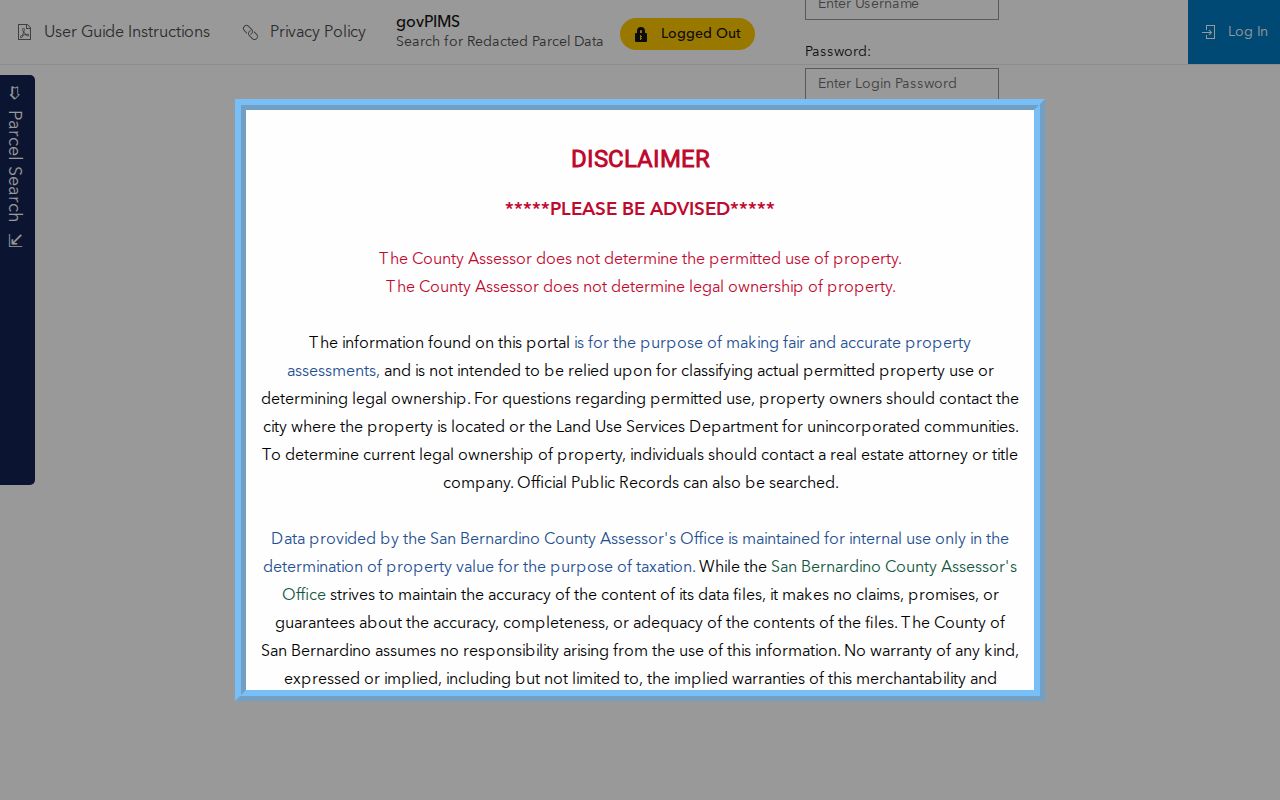
The map view helps confirm which polygon belongs to the address, while the property tabs supply the APN and history needed for later deed and permit checks.
Define Rialto Address Records
Three address identities often get mixed together in a street directory. The county separates the physical place from the destination for tax mail, and a recorded deed uses a legal description that can remain stable when a street label changes. A map also has its own vocabulary. Knowing these terms prevents a plausible record from being assigned to the wrong parcel.
- Parcel
- A distinct piece of land tracked by an assessor parcel number, with geometry and assessment fields in the county system.
- Situs address
- The physical location of the parcel. It is not automatically the owner's mailing address or proof that the owner occupies the property.
- Plat
- A recorded subdivision map that helps connect lots, blocks, easements, and parcel geometry to a legal land description.
- Criss-cross directory
- A reverse directory organized by street and number so a researcher can look for an occupant or business without starting with a surname.
For a current Rialto parcel, record the situs, mailing field, APN, tract or lot reference, and the date of the result as separate facts. A mailing address can belong to an absentee owner, trust, manager, or other destination. A legal description can point to the same land when a modern street search uses a different spelling or number.
Read Rialto Street Parcel Geometry
The Public Assessor Map and Parcel Access viewer lets a researcher pan, zoom, and select parcels. Browsing a whole Rialto street therefore reveals parcel geometry, APNs, and public assessment detail, not a resident roster. Click the parcel polygon that matches the target address rather than assuming that the next street number is the next property. Corner lots, rear lots, attached parcels, and cul-de-sacs can break that shortcut.
Tract and parcel maps add the lot and block frame around the search. They can show why two addresses that look close are separated by a lot line or why one parcel has a different legal description. For a recorded map copy, ARC directs map-copy work to the San Bernardino location. For a map-only question, the free online viewer is the faster channel; for a title or boundary question, use the official map or deed record rather than drawing a conclusion from a screen image.
The geometry also matters at Rialto's edges. ZIP 92376 and 92377 are the city's principal postal identities, while nearby 92316 is associated with Bloomington. A postal city does not decide incorporated jurisdiction. USPS address verification and county GIS should be checked separately before a city permit or records request is sent.
Rialto's Lytle Creek annexation materials state that Neighborhoods 2 and 3 became city territory on July 25, 2016. The city grew from 22.3 to 24.1 square miles, while the El Rancho Verde area remained an approximately 212-acre county island. No official source in the research established a systematic Rialto street-renumbering chronology, so old addresses must be bridged with plats, maps, and source notes rather than an invented conversion table.
Note: The county elections office at 777 E. Rialto Avenue is in San Bernardino, so a street name alone must never decide the responsible jurisdiction.
Follow Rialto Deeds From a Street
The ARC recorder index is a catalog, not an online deed-image library. After accepting the self-service disclaimer, search grantor or grantee names, document number, recording date, and document title. It does not accept a street address as a substitute for a party or recording reference. The reliable sequence is current parcel, current owner lead, acquisition deed, named transferor, then the earlier transferor as a new grantee search.
The public index begins in 1925. ARC's property-research workflow describes a 1958-present grantor and grantee process plus pre-1958 decade microfilm at the main Recorder office, while the general official-records page states the index begins in 1925. Keep both statements in the research notes. At the earlier edge, ask counter staff which book or microfilm series covers the year, and carry the legal description rather than relying on a street number.
Recorded images can be inspected at the Hall of Records or the High Desert Government Center. Copies can be ordered online, requested by mail, or obtained in person. The published copy schedule lists $4 for the first page and $1.50 for each additional page, with a $1.50 per-page certification charge; online card payments add 3.5 percent. Mail copies are stated as returning in one to two weeks after receipt. The official recorder page is the correct starting point for current instructions and office appointments.
Ownership still is not occupancy. A deed records a transfer party and legal description. It does not identify every household member, and it may show a mailing destination away from the Rialto situs. Pair the deed date with an assessment record, permit file, directory entry, census snapshot, or other dated source before describing a past resident.
Note: A recorder index hit gives a document number, date, title, and indexed parties; the instrument's full terms require a counter inspection or an official copy.
Request Rialto Street Permits by Address
Rialto permit and code records add a time line to a street address. The City Clerk's CPRA form uses permits for an address as its own example. Ask for an identifiable existing record with the street number, street name, APN if known, record type, and date span. Existing records may include permit cards, applications, inspection dates, contractor or applicant names, project descriptions, valuation, final status, and code notices. An applicant's connection to a parcel is evidence about a project, not proof of residence.
The current Rialto public-records page links a Hyland Records Search and a separate online request portal. The older City Clerk request form shows the address-based permit example and field inventory. The City Clerk is at 290 W. Rialto Avenue, 909-820-2519, Monday through Friday from 7 a.m. to 6 p.m. Documented submission routes include office delivery or mail, the online portal, and email to cityclerk@rialtoca.gov. The form has a fax field, but it does not expressly promise fax acceptance. Current pricing is $0.30 per paper page and no charge for email copies. CPRA supplies a 10-calendar-day determination period, not a guaranteed production date.
The Rialto Online Permitting Center covers Building and Safety, Planning, Business License, Fire Prevention, and Engineering. Account linking asks for first name, last name, permit number or numbers, and account email. Published statuses include Closed, Corrections Required, Denied, Expired, Finaled, Fees Due, In Review, Issued, Permit Processing, Routed for Review, and Stop Work Order. The City's permits and licenses hub also routes alarm, bicycle, business, and dog licensing, but no public name roster was verified. Building questions can be directed to rialtobuilding@rialtoca.gov or 909-820-2505 option 1, but an unauthenticated public result field set was not verified.
The Rialto Online Permitting Center is useful when an account or permit number is available, while the City Clerk is the documented fallback for a focused address request.
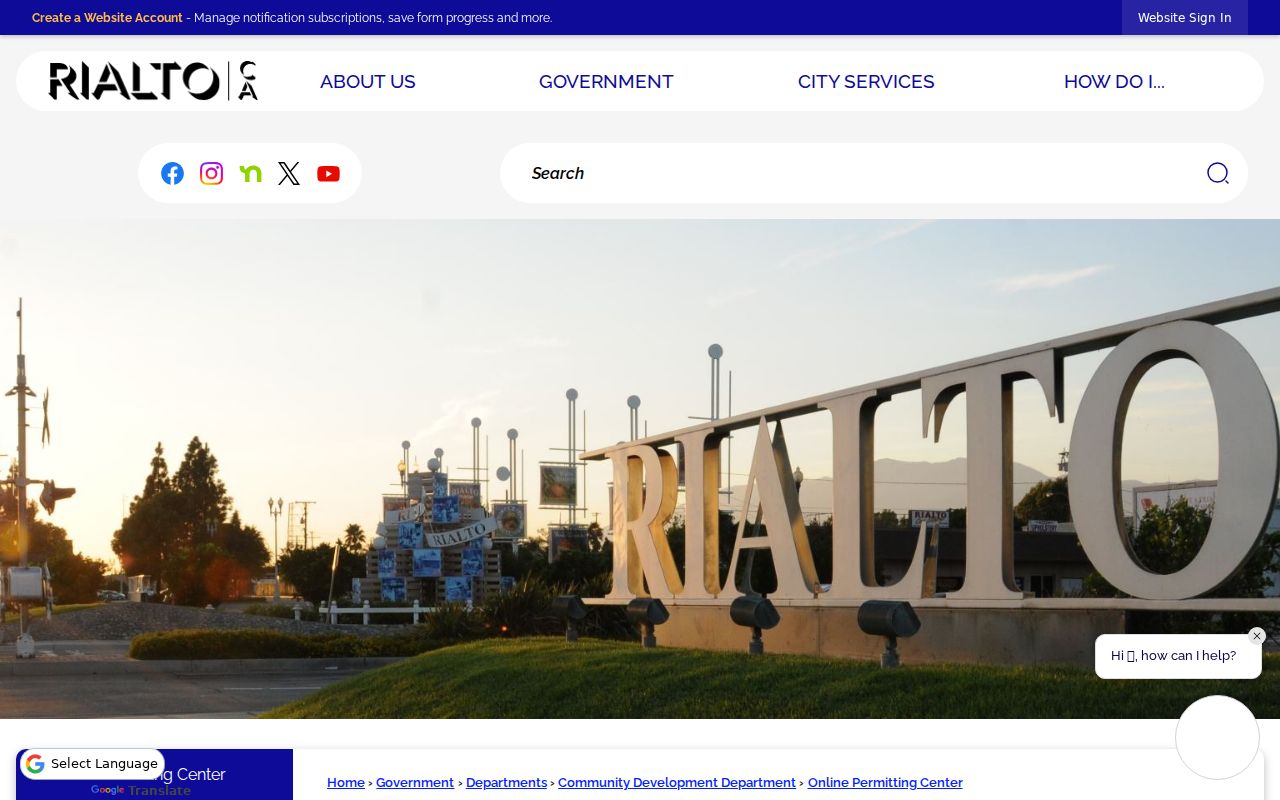
Permit status labels can place a documented change on a street timeline, but they should be read with the project date, parcel, and custodian's redactions in view.
Rialto Street Voter Information Access
Voter records are not a public street directory in San Bernardino County. My Elections Gateway authenticates a person's own registration and can return registration status and locations, districts, a voter information guide or sample ballot, polling place, mail-ballot drop-off information, provisional status, election information, elected officials, and campaign-finance links. The portal says voting history is currently unavailable online and directs the voter to 909-387-8300.
The Registrar of Voters is at 777 E. Rialto Avenue, San Bernardino, CA 92415-0770. The listed contact is Communications@rov.sbcounty.gov and the phone is 909-387-8300. The address contains the word Rialto but is not a City of Rialto office. That geography check prevents a street directory search from sending a municipal question to the county elections desk by mistake.
A broader county voter-file request is a separate channel. The county application requires in-person or mail submission with a wet signature, government ID, intended-use narrative, and security plan. Purpose choices include election, political, scholarly, journalistic, governmental, and record review. A specific-voter request permits up to ten records; published charges are $38 through 80,000 records, $86 for 80,001 to 250,000, and $93 above 250,001, with approval-to-delivery stated as three to five business days. The Secretary of State request page also describes approved-purpose access, a $30 specific-record charge, and a $100 cap.
California Elections Code sections 2188 and 2194 limit voter-file access to approved purposes, bar commercial use, and protect signatures and identification numbers. A confidential voter or Safe at Home participant may have extra protection. The lawful result is a person's authenticated self-lookup or an approved request handled under its stated rules, not a copied list of Rialto addresses.
Find Older Rialto Street Directory Occupants
Historical reverse directories are the best fit when the question is who occupied a Rialto address at a past date, but the local shelf is not fully documented. Ask the public library directly about Rialto city directories, reverse telephone directories, Rialto Record microfilm, school yearbooks, obituary clipping files, and in-library genealogy databases. No official catalog page in the research established exact local directory years or publishers, so a claimed volume should be checked by title, year, holding institution, and page image.
Regional sources add firmer anchors. The National Archives at Riverside lists San Bernardino directories that include Rialto for 1930 and 1933 to 1934, and its Southern California genealogy channel supports a research-room visit, catalog work, or an order. FamilySearch identifies the 1949 San Bernardino Directory Co.'s San Bernardino city directory: including Colton and Rialto. Access to a digital or library copy may be gated. A reverse section, when a volume has one, is searched by street and number; an alphabetical section starts with a surname. Follow the publisher's abbreviation key and do not infer an owner, spouse, or resident from an unexplained mark.
The Rialto Directory Book separates the historical collection question from the current parcel chain. For a street directory search, record the exact address, entry wording, page citation, and neighboring annual volume. Then compare the occupant clue with a census schedule open through 1950, an assessment or deed date, a permit, or a newspaper notice.
Note: The absence of a confirmed local shelf run is a research gap, not permission to fill a Rialto directory page with an invented year or household entry.
Rialto Street Records and Agency Addresses
Official agency directories can confirm where to send a records request, but they are not resident rolls. The San Bernardino County District Attorney's law-enforcement directory lists Rialto Police at 128 N. Willow Avenue with telephone 909-820-2550. Police reports are requested from the records custodian and may be redacted for victims, witnesses, juveniles, medical details, address-confidentiality participants, and active investigations.
The county law-enforcement agency directory is therefore an office-routing source within a Rialto street directory workflow, not proof that a public official or caller lives at the listed location.
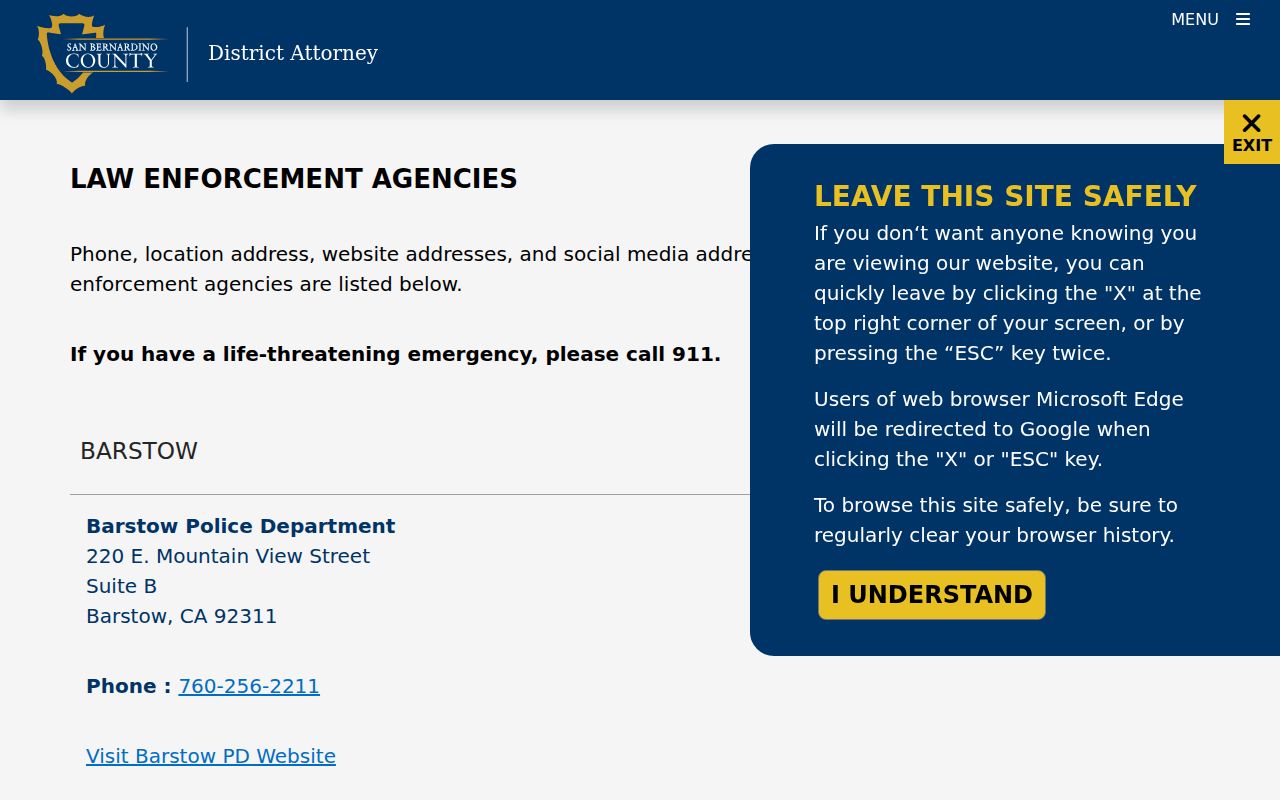
Using the agency listing for the correct custodian keeps a street-related request tied to an official office and avoids treating a public agency address as a private residence.
Where a Rialto Street Directory Stops
A parcel record can show an APN, situs, public owner field, mailing field, value history, and map context. It cannot name every renter, household member, guest, or utility customer. DMV address data are restricted by the federal Driver's Privacy Protection Act and California law. Utility accounts and delivery records are not public neighborhood fields. A permit applicant, deed party, or tax mailing recipient is connected to an address at a point in time, not automatically a current resident.
California's Safe at Home program uses a substitute mailing address for eligible participants, and Government Code section 7928.205 protects specified official and participant home-address information in assessor data. A missing name may reflect a legal protection, a portal scope rule, an entity owner, or ordinary record limits. It should not be treated as proof that no one lives at the parcel.
For a personal, lawful question, preserve the source URL, as-of date, APN, and record type, then verify a disputed fact with the custodian that created it. Do not copy protected voter data, publish a block roster, or use a public record to target a person. California Penal Code section 646.9 addresses stalking, and sections 422 and 653.2 can apply to threats or repeated electronic harassment; civil harassment orders are addressed by Code of Civil Procedure section 527.6.
Lawful use. Rialto street and address records support personal research, family history, property curiosity, and safe civic contact. Using them to stalk, threaten, harass, intimidate, or harm another person is prohibited and may be criminal.